
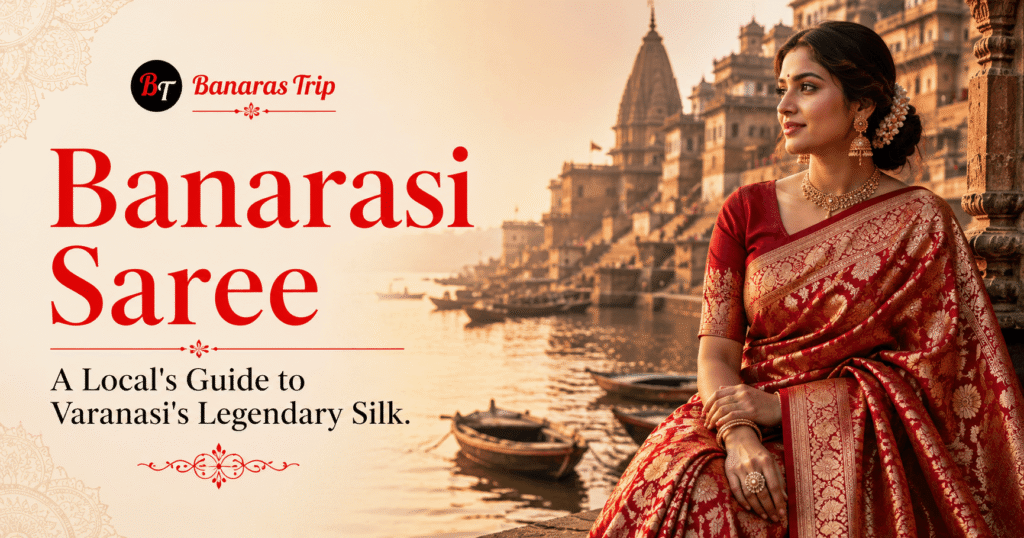

Walk any lane near the ghats and you will be offered a “pure Banarasi saree” within minutes. Some of it is the real thing, woven on a handloom a few streets away. A lot of it is not. We are Team Banaras Trip, a Varanasi-based team that has spent years walking these same lanes, and this guide is written to help you understand what a genuine Banarasi saree actually is, the different types, what it should cost, and how to tell an original handloom silk from a power-loom copy before you pay.
The Banarasi saree is one of India’s finest woven textiles and a signature of this city. Getting a real one is not about spending the most money. It is about knowing what you are looking at, which is exactly what living here teaches you.
What Is a Banarasi Saree?
A Banarasi saree is a handwoven silk saree made in and around Varanasi (Banaras), known for its fine silk, rich gold and silver zari brocade work, and intricate Mughal-influenced motifs. Traditionally woven on handlooms by weaver families in the old city, a genuine Banarasi is prized as a heirloom and bridal saree across India.
The craft is protected by a Geographical Indication (GI) tag, which legally ties the name “Banaras Brocades and Sarees” to sarees actually produced in the Varanasi region. The GI was granted in 2009. [VERIFY: confirm exact GI grant year and registered name before publishing.]
A Short History of the Banarasi Saree
Silk weaving in the Varanasi region is centuries old, but the Banarasi saree as we know it, heavy with gold zari and Mughal design, took its recognisable form under Mughal patronage. The floral and foliate patterns, the paisley (konia) motifs, the intertwining vines, all of it carries clear Persian and Mughal influence that the local weavers absorbed and made their own.
For generations the craft passed down through Muslim and Hindu weaver families side by side in the same lanes, and that shared inheritance is still visible in the weaving clusters of the city today. The industry has had hard decades, squeezed by cheaper power-loom production and imported synthetics, which is exactly why knowing how to identify and buy a genuine handloom piece matters, both for you and for the weavers who still do it by hand.
How a Banarasi Saree Is Made
A real Banarasi saree is woven on a handloom, not printed and not power-loom mass-produced. The design is first worked out on graph paper, then translated into a set of punch cards (a jacquard system) that guide the loom. Silk threads form the base, and the gold or silver zari is woven in to create the raised brocade patterns.
This is slow work. A simple design might take around 15 days, while an elaborate bridal saree with dense zari can take several months, and the most intricate pieces close to a year, often with more than one weaver working the loom. [VERIFY: confirm typical weaving-time ranges from a handloom/textile source.] That labour is the single biggest reason a genuine Banarasi cannot be cheap.
Types of Banarasi Sarees
“Banarasi” is a family of sarees, not one single fabric. They are grouped two ways: by the base material and by the weaving style or motif work. Here are the ones you will actually be shown in Varanasi.
By base fabric
| Type | What it is | Best for |
|---|---|---|
| Katan (pure silk) | Woven from pure silk threads, the classic and most durable Banarasi. | Bridal, heirloom, formal occasions |
| Organza / Kora with zari | Lightweight, sheer, with brocade and zari work. | Lighter formal wear, warmer weather |
| Georgette | Softer, more fluid drape woven on a georgette base. | Everyday-elegant and party wear |
| Shattir | A lighter, more contemporary and affordable base. | Modern, budget-friendlier options |
By weaving style and motif
- Jangla: dense, all-over vegetation and vine patterns in colourful silk threads.
- Tanchoi: fine, closely woven patterns with no long floats on the back, often small repeating motifs.
- Cutwork: a lighter, more affordable look created by cutting away floating threads on the reverse.
- Tissue: shimmering sarees woven with zari to give a golden, watery sheen.
- Butidar: sarees covered in small brocade motifs (butis) in gold and silver thread.
How to Identify an Original Banarasi Saree
To identify an original handloom Banarasi saree, check the reverse side for floating threads, test a stray thread by burning it, look for GI or Silk Mark tags, and be realistic about price. A genuine pure-silk Banarasi with real zari simply cannot be sold cheaply. These are the checks we actually use.
- Turn it over. On a real handloom Banarasi, the back shows floating threads (floats) behind the motifs, and the pattern is not perfectly clean. Power-loom copies look suspiciously neat and identical on the reverse.
- The burn test on a loose thread. Pure silk burns slowly to a fine ash and smells like burnt hair. Synthetic (polyester/art silk) melts, curls into a hard bead, and smells like burning plastic. Only ever do this on a stray thread, and with the seller’s permission.
- Look for the marks. Genuine handloom silk often carries a Silk Mark or Handloom Mark tag, and true Banarasi is covered by the GI tag. Ask the seller directly.
- Feel and weight. Pure silk feels cool, smooth, and has a soft natural sheen rather than a harsh, flat shine.
- Respect the price. If a “pure silk Banarasi with real zari” is being offered for a few hundred or a couple of thousand rupees, it is almost certainly power-loom or synthetic. Real zari alone costs more than that.
Banarasi Saree Price: What to Expect
Banarasi saree prices vary enormously depending on whether the base is pure silk, whether the zari is real, and how dense the weaving is. The ranges below are broad market figures as of early 2026, meant only to set expectations. Confirm current prices with the seller, as they move with silk and zari rates. [VERIFY: current market price bands from a retail/handloom source.]
| Category | Rough price range | Notes |
|---|---|---|
| Lighter bases (Shattir, Georgette, Organza) | Lower end, a few thousand rupees upward | More affordable, still handwoven if genuine |
| Pure Katan silk, moderate zari | Mid range, roughly tens of thousands | The classic wedding-guest and gifting range |
| Bridal, heavy real-zari, intricate | High end, into lakhs | Months of work, often real gold/silver zari |
Where to Buy an Authentic Banarasi Saree in Varanasi
The genuine article comes from the weaving clusters, not the ghat-front stalls aimed at tourists. Varanasi’s silk-weaving neighbourhoods include areas like Madanpura, Alaipura, Peeli Kothi and Lallapura, and the surrounding lanes where weaver families still run handlooms at home. [VERIFY: confirm current active weaving-cluster names/areas locally before publishing.]
Our honest advice, from watching this happen for years:
- Be cautious of anyone who stops you near the ghats or outside Kashi Vishwanath insisting on a “special weaver price.” That is usually a commission chain, not a saving.
- Buy from a fixed shop or directly from a weaver you have been taken to by someone local and trustworthy.
- Ask to see the reverse, ask about the base fabric and zari, and do not be shy about the checks above. A genuine seller will not mind.
This is one area where a local hand genuinely helps. Our team can take you to established weavers and shops we know, so you see the loom, understand what you are buying, and pay a fair, fixed price instead of a tourist markup.
Which Banarasi Saree Should You Choose?
For a wedding or an heirloom piece you will keep for decades, a pure Katan silk with real zari is worth the investment. For gifting or festival wear, a mid-range Katan or a Tissue saree gives you the Banarasi look without bridal weight. If you want something to wear often or you are travelling light, a Georgette or Organza Banarasi drapes easily and is far more practical. There is a genuine Banarasi at almost every level. The goal is only to make sure it is genuine.
Frequently Asked Questions
What is a Banarasi saree?
A Banarasi saree is a handwoven silk saree made in and around Varanasi, known for its fine silk, gold and silver zari brocade, and intricate Mughal-influenced motifs. Genuine Banarasi sarees are woven on handlooms by local weaver families and are protected by a Geographical Indication (GI) tag.
How do I identify an original Banarasi saree?
Check the reverse side for floating threads behind the motifs (handloom weaving is not perfectly clean on the back), test a stray thread with a burn test (pure silk turns to ash and smells like burnt hair, synthetic melts into a bead), look for a Silk Mark or Handloom Mark tag, and be realistic about price, since a genuine pure-silk saree with real zari cannot be cheap.
Why are Banarasi sarees so expensive?
Because a genuine Banarasi is woven by hand, and that takes time. A simple design can take around two weeks, while an elaborate bridal saree with dense zari can take several months, sometimes close to a year. Add pure silk and real gold or silver zari, and the cost reflects the labour and materials, not a markup.
What are the main types of Banarasi sarees?
By fabric, the main types are Katan (pure silk), Organza or Kora, Georgette, and Shattir. By weaving style, common types include Jangla, Tanchoi, Cutwork, Tissue, and Butidar. Katan pure silk is the classic bridal and heirloom choice.
Where can I buy an authentic Banarasi saree in Varanasi?
Buy from the weaving clusters and established fixed-price shops rather than ghat-front tourist stalls, and ideally go with someone local you trust. Much of the “Banarasi silk” sold casually to tourists is power-loom or synthetic, so seeing the loom and checking the fabric matters.
How long does it take to make a Banarasi saree?
It depends on the design. A simple Banarasi can take around 15 days, while intricate, heavily brocaded bridal sarees can take several months, and the most elaborate designs close to a year, often with more than one weaver working the same loom.
Let’s Explore Banaras With Team Banaras Trip
Buying a genuine Banarasi saree is far easier when someone local walks you to the right loom. We are a Varanasi-based team, the #1 tour and travel agency in Varanasi, active since 2016 with 300+ trips and a 4.9/5 rating from 422+ reviews. Alongside guided tours, ghat visits, and the Ganga Aarti, we can take you to weavers and shops we actually know, so you buy with confidence.


