
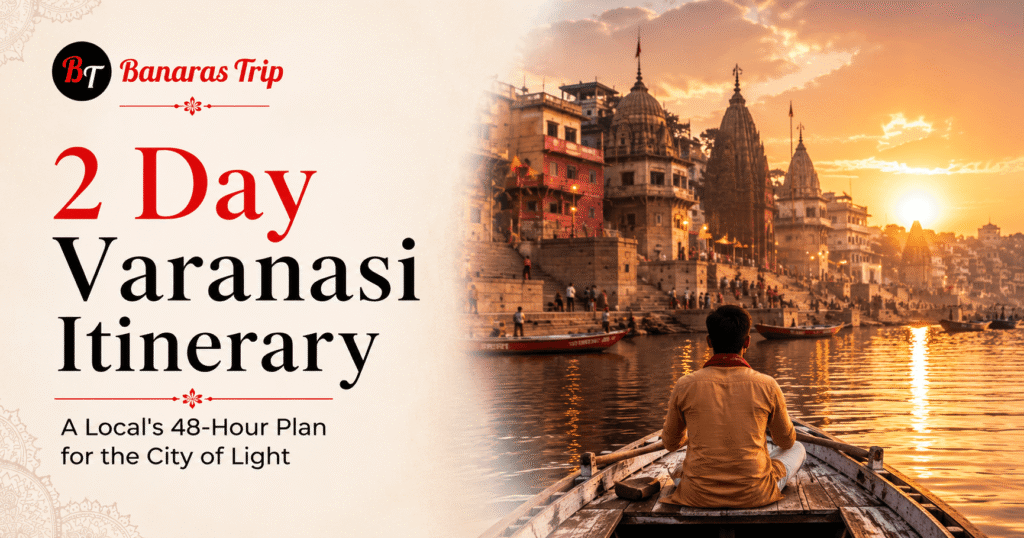

Two days is not a lot of time for a city that has been lived in for over 3,000 years, but it is enough to see the Banaras that matters if you plan the hours well. We are Team Banaras Trip, born and raised here, and this 2 day Varanasi itinerary is the exact sequence we hand our own guests: a sunrise boat ride when the river is quiet, the Ganga Aarti when it roars to life, Kashi Vishwanath, and a half day in Sarnath where the Buddha gave his first sermon. No filler, no running around the city twice for the same lane.
The trick with 48 hours in Varanasi is not fitting in more places. It is getting the order right so the light, the crowds, and the aartis all line up. That is what most travel-blog itineraries get wrong, and it is where living here for 10+ years actually helps.
Is 2 Days Enough for Varanasi?
Yes, two full days is enough to experience the heart of Varanasi without feeling rushed, as long as you base yourself near the ghats and follow a tight morning-and-evening rhythm. In two days you can comfortably cover a sunrise boat ride, the main ghats, Kashi Vishwanath Dham, the Dashashwamedh Ghat Ganga Aarti, and a half-day trip to Sarnath.
What you will not have time for in two days is Ramnagar Fort in depth, a Prayagraj or Ayodhya add-on, or the slow, aimless ghat-wandering that Varanasi rewards. If your trip is mainly spiritual and you want to add temples like Sankat Mochan and Durga Kund at a relaxed pace, three days suits you better. For a first visit built around the river and the old city, two days works well.
Your 2 day Varanasi itinerary at a glance
| Time | Day 1 (River & Old City) | Day 2 (Sarnath & Slow Banaras) |
|---|---|---|
| Early morning | Sunrise boat ride on the Ganga | Subah-e-Banaras at Assi Ghat |
| Late morning | Old-city breakfast + Kashi Vishwanath Dham | Sarnath (Dhamek Stupa, museum, temples) |
| Afternoon | Rest, then Banarasi silk lanes / Vishwanath Gali | BHU campus & New Vishwanath Temple |
| Evening | Ganga Aarti at Dashashwamedh Ghat | Relaxed ghat walk + rooftop cafe dinner |
Day 1: Ghats, the Old City, and the Ganga Aarti
Day one is the classic Varanasi day. It runs on two peaks, sunrise on the river and the evening aarti, with the old city and Kashi Vishwanath in between. Keep the middle of the day light, because the humidity and the crowds both build after 11 AM.
5:30 AM: Sunrise boat ride on the Ganga
Start before the sun does. We usually recommend being on the water by around 5:30 AM in summer and closer to 6:00 AM in winter, because the whole mood of Varanasi is different in that first half hour of light. The ghats glow amber, priests take their morning dip, and the river is calm enough to hear the oars. [VERIFY: confirm exact sunrise-slot timing for the travel month, as it shifts by season.]
A rowing boat is better than a motorboat for this. It is slower, quieter, and lets you drift close to the ghats. Push off from around Dashashwamedh or Assi Ghat and go upstream toward the cremation ghats. You will pass Manikarnika Ghat, where the fires burn day and night, and this is the most honest way to understand what Banaras is really about. Photography of the burning ghats is not allowed out of respect, so keep the camera down there.
- Government-set shared and private boat rates are displayed at the ghats. As of early 2026 these are modest and fixed by category, but confirm the current rate board before you step in. [VERIFY: current official boat rate slabs.]
- Carry small change and settle the rate before boarding, not after.
- The 5:30 AM light is better than the evening for photos. Fewer crowds too.
If you would rather not haggle at the ghat at dawn, our team pre-arranges a clean, safe rowing boat and a local boatman who knows exactly where to slow down. Click here to get the prices
8:00 AM: Breakfast in the old city
Come off the boat hungry and walk up into the lanes for a proper Banarasi breakfast. The classic is kachori-sabzi with a clay cup of chai, and for something sweet, hot jalebi straight out of the kadhai. The lanes around Godowlia and Kachori Gali are where locals actually eat, not the ghat-front tourist cafes. Finish with a Banarasi paan if you want the full ritual.
9:30 AM: Kashi Vishwanath Dham
Kashi Vishwanath is one of the twelve Jyotirlingas and the single most important temple in the city. Since the Kashi Vishwanath Dham corridor opened in December 2021, the whole approach changed: there is now a wide riverfront complex connecting the ghats to the temple, which makes the walk far easier than the cramped old lanes used to be.
A few things that save you time and stress at the temple:
- Phones, cameras, leather items and bags are not allowed inside. Use the free cloakroom facilities near the entry, or better, leave valuables at your hotel.
- Queues are shortest early. Mid-morning on a normal weekday is manageable; Mondays, Shivratri, and the month of Sawan are extremely crowded. [VERIFY: current darshan timings and any special-entry / aarti ticket rules on the official site.]
- There are paid sugam darshan and aarti passes if you want to skip the general line. Check the official portal before you go.
Afternoon: rest, then the silk lanes
Go back to your hotel for a couple of hours through the hottest part of the day. In the late afternoon, dip into Vishwanath Gali and the surrounding lanes for Banarasi silk. This is the home of the real Banarasi saree, and if you want to buy one, ask your host or our team where the genuine weavers sell, because the lanes are also full of power-loom imitations sold as handloom.
6:30 PM: Ganga Aarti at Dashashwamedh Ghat
This is the reason most people come to Varanasi. Every evening at Dashashwamedh Ghat, a line of young priests perform a synchronised fire aarti to the Ganga with heavy brass lamps, conch shells, and drums. It usually begins around sunset, roughly 6:00 to 7:00 PM depending on the season, and runs for about 45 minutes. [VERIFY: exact current aarti start time for the travel month.]
Our honest local tip: arrive at least 45 minutes early. The steps fill fast. For the best view without the crush, watch from a boat anchored just off the ghat, which also lets you leave whenever you like. It is calmer, cooler, and the photos are better from the water looking in.
There is also a quieter, more intimate aarti at Assi Ghat if the Dashashwamedh crowd feels like too much on a festival evening.
Day 2: Sarnath, Assi Ghat, and a Slower Banaras
Day two pulls back from the intensity of the old city. The morning is gentle at Assi Ghat, the middle of the day is a Buddhist half-day in Sarnath, and the evening is deliberately unstructured so you actually rest before you travel on.
5:45 AM: Subah-e-Banaras at Assi Ghat
Assi Ghat runs a daily morning programme called Subah-e-Banaras, a sunrise ritual of Vedic chanting, a small aarti, and often live classical music and yoga on the ghat. It is calmer and less commercial than the evening Dashashwamedh crowd, and it is one of our favourite ways to start a second day. [VERIFY: confirm current Subah-e-Banaras start time and whether yoga/music sessions are running.]
9:30 AM: Sarnath
Sarnath is where Gautam Buddha delivered his first sermon after attaining enlightenment, which makes it one of the four holiest sites in Buddhism. It sits about 10 km from central Varanasi, so a half day covers it comfortably. [VERIFY: exact distance/drive time from your hotel.]
What to see there:
- Dhamek Stupa is the huge cylindrical monument marking the spot of the first sermon, maintained by the Archaeological Survey of India.
- The Sarnath Archaeological Museum holds the original Lion Capital of Ashoka, the sculpture that became India’s national emblem. The museum is typically closed on Fridays, so avoid a Friday visit. [VERIFY: current museum days and entry fee.]
- The Mulagandha Kuti Vihar and the surrounding monasteries built by Thai, Japanese, Tibetan, and other Buddhist communities are worth an unhurried walk.
Sarnath is green, quiet, and a genuine change of pace from the density of the ghats. If you have any interest in history or Buddhism, do not cut it.
Afternoon: BHU campus and the New Vishwanath Temple
On the way back, stop at Banaras Hindu University, one of the largest residential universities in Asia, with a calm, tree-lined campus. Inside it is the New Vishwanath Temple (also called Birla Temple), a tall marble temple open to all visitors regardless of faith, which the original Kashi Vishwanath historically was not. If you would rather see the river again, swap this for Ramnagar Fort across the Ganga, though the fort needs more time and its museum is faded. [VERIFY: BHU visitor-entry rules and Ramnagar Fort timings/entry fee.]
Evening: a slow ghat walk and a rooftop dinner
End the trip the way locals actually enjoy the ghats: slowly, on foot, with no schedule. Walk the stretch from Assi Ghat toward Dashashwamedh as the sky changes, watch the boats come in, and then eat dinner at one of the rooftop cafes overlooking the river. It is the reset your legs need before an early train or flight out.
Best Time to Do This 2 Day Varanasi Itinerary
The most comfortable window is October to March. Winter mornings on the river are cool and clear, which is exactly when the sunrise boat ride is at its best. October and November also bring Dev Deepawali and the post-Diwali season, when the ghats are lit with thousands of diyas, though the crowds are heavier then.
| Season | Months | What to expect |
|---|---|---|
| Winter (best) | Oct to Mar | Cool, clear mornings, ideal for boat rides and long walks. Peak festival season. |
| Summer | Apr to Jun | Very hot. Start earlier, rest through midday, keep afternoons indoors. |
| Monsoon | Jul to Sep | The river runs high and fast. Boating is sometimes restricted for safety. |
Practical Tips From Our Team
A few things that make a two-day trip smoother, learned from doing this hundreds of times:
- Stay near the ghats. The old city is a maze of narrow lanes where cars cannot go. A hotel near Assi or Dashashwamedh saves you an hour of walking each way.
- Wear slip-on footwear. You will remove your shoes constantly at temples, and lanes can be wet near the ghats.
- E-rickshaws drop you at the lane mouth, not the ghat. The last stretch to the river is always on foot.
- Cover shoulders and knees for temple entry, and keep a scarf handy.
- Keep valuables minimal at Kashi Vishwanath, since phones and bags cannot go in.
- Do not photograph the cremation ghats. It is deeply disrespectful and locals will rightly stop you.
How to Do This Trip Without the Logistics Headache
Varanasi rewards local knowledge more than almost any city in India. The difference between a good trip and a frustrating one is usually small things: the right boat at the right time, a guide who knows which lane skips the crowd, and a driver who understands the Sarnath detour. We are a Varanasi-based team, active since 2016 with 300+ trips completed and a 4.9/5 rating from 422+ reviews, and we build these two-day plans around exactly what you want to see.
As Lakshmi told us after her trip with us, the whole thing was very well planned and smoothly managed. That is the entire job of a local team: you experience Banaras, we handle the moving parts.
You can explore our Varanasi ghats guides, temple and religious-place guides, Sarnath travel guides, places to visit in Varanasi, events and festivals, and rooftop cafes near the ghats for more planning ideas. If you are extending the trip, our Prayagraj travel guides and Ayodhya travel guides cover the natural next stops, and our boat ride and Ganga Aarti booking pages, plus real guest reviews, show how we run these experiences on the ground.
Frequently Asked Questions
Is 2 days enough to see Varanasi?
Yes. Two full days is enough to cover a sunrise boat ride, the main ghats, Kashi Vishwanath, the evening Ganga Aarti, and a half day in Sarnath. You will not have time for Ramnagar Fort in depth or for day trips to Prayagraj or Ayodhya, which need extra days.
What is the best 2 day Varanasi itinerary?
Spend day one on the river and old city (sunrise boat ride, Kashi Vishwanath, and the evening Ganga Aarti at Dashashwamedh Ghat), and day two on a slower Banaras (Subah-e-Banaras at Assi Ghat, a half day in Sarnath, and BHU). The key is doing sunrise on the water and aarti in the evening, with the temple and lanes in between.
How much does a 2 day Varanasi trip cost?
It depends on your hotel category, whether you take private or shared transport, and how you do the boat ride and Sarnath trip. Public costs like the boat rate board and temple entry are modest and fixed, but a fully arranged two-day package varies by group size and inclusions. Click here to get the prices
What is the best time of year to visit Varanasi for two days?
October to March. Winter mornings are cool and clear, which is ideal for the sunrise boat ride and long ghat walks. Summers (April to June) are very hot, so you must start earlier and rest through midday.
Can I cover Sarnath in a 2 day Varanasi itinerary?
Yes. Sarnath is about 10 km from central Varanasi and fits comfortably into a half day on day two. Cover the Dhamek Stupa, the Sarnath Archaeological Museum (closed Fridays), and the Mulagandha Kuti Vihar, then head back to the city by afternoon.
What time is the Ganga Aarti at Dashashwamedh Ghat?
The evening Ganga Aarti happens daily and usually begins around sunset, roughly between 6:00 PM and 7:00 PM depending on the season, running about 45 minutes. Arrive at least 45 minutes early for a spot, or watch from a boat for the best view. Confirm the exact start time before your visit, as it shifts through the year.
Let’s Explore Banaras With Team Banaras Trip
If you want this two-day plan handled end to end, the right boat at sunrise, a guide through the lanes, Sarnath sorted, and a good hotel near the ghats, we will build it around your dates and your pace. Banaras Trip is a fully local team, the #1 tour and travel agency in Varanasi, and we would love to plan your 48 hours in the City of Light.


